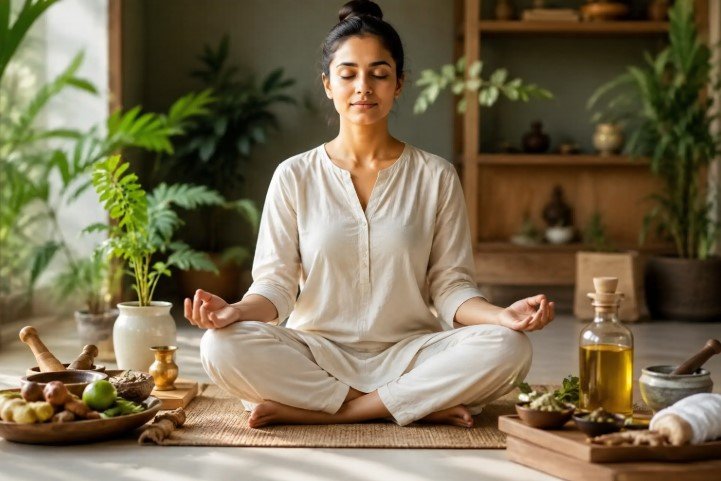
Mental strain does not always announce itself with a crisis. More often, it shows up as a mind that will not switch off, a body that feels tired without reason, and a low-grade tension that never fully lifts. For NRIs and foreigners connected to India, this weight often carries an extra layer — distance from family, unresolved questions about identity, and constant background worry about parents back home. The ayurveda approach to mental health offers a different starting point than most modern stress advice. Instead of separating the mind from the body, Ayurveda treats them as one connected system that rises and falls together. Anxiety, low mood, and burnout are read as signs of imbalance, not simply as stress to push through. This guide looks at how Ayurveda understands mental health, what ayurvedic stress management actually involves in daily life, and where natural mental wellness remedies realistically fit into a routine lived partly outside India.
Why Ayurveda Treats the Mind and Body as One System
Ayurveda is thousands of years old, but its central idea about mental health has aged well: the mind struggles to stay steady while the body is constantly out of rhythm, and the body struggles to heal while the mind stays overloaded. Ayurveda calls the mind manas, and treats it as something shaped directly by digestion, sleep, daily routine, and the senses. This is different from treating mental health and physical health as two separate departments that occasionally overlap. Disturbed digestion, broken sleep, or constant sensory overload is expected to show up eventually as anxiety, irritability, or fatigue. This is one reason how Ayurveda is traditionally practiced in India often looks less like a single treatment and more like a full recalibration of daily life.
The Three Doshas and How They Shape Your Stress Response
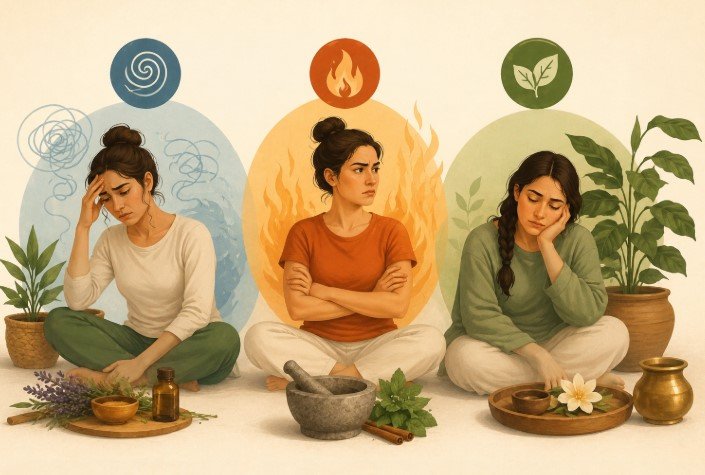
Ayurveda groups the body’s tendencies into three doshas — Vata, Pitta, and Kapha. Everyone carries all three, but stress usually pulls a person toward one dominant pattern.
Vata and the Anxious, Overthinking Mind
Vata governs movement, including the movement of thought. When Vata rises under stress, people describe racing thoughts, difficulty sitting still, disrupted sleep, and a wired-but-tired feeling. This pattern is common among people juggling multiple time zones, constant travel, or irregular schedules.
Pitta and the Irritable, Overheated Mind
Pitta governs transformation and intensity. Under pressure, Pitta types often become sharp, impatient, or prone to anger. Deadlines, competition, and a strong need for control tend to aggravate this pattern, often alongside physical signs like acidity or skin flare-ups.
Kapha and the Heavy, Withdrawn Mind
Kapha governs stability and structure. When stress tips into Kapha imbalance, it often looks like heaviness, low motivation, emotional withdrawal, and reluctance to engage with people or tasks. This pattern is sometimes mistaken for laziness rather than recognised as a stress response.
Recognising which pattern shows up most often is usually the real starting point of ayurvedic stress management, since the recommended routine, food, and practices shift depending on the dosha involved.
How Ayurveda Explains the Root Causes of Anxiety and Burnout
Ayurveda does not treat stress as something that begins in the mind alone. It traces anxiety and burnout back to disturbances in agni (digestive fire), disrupted sleep cycles, and prolonged sensory overstimulation. When digestion weakens, Ayurveda describes a build-up of ama, a kind of internal residue believed to cloud clarity and heighten emotional reactivity. Modern research on stress physiology, including guidance published by the World Health Organization, points to a similar loop: poor sleep and irregular routines make the nervous system more reactive, which then makes stress harder to recover from. Ayurveda’s contribution is less about diagnosing a condition and more about identifying which daily habits are quietly feeding that cycle, often years before anxiety becomes hard to ignore.
Core Ayurvedic Principles Behind Mental Wellness
Three ideas repeat across almost every Ayurvedic text on the mind: routine, food, and rest.
Dinacharya — Daily Routine as an Emotional Anchor
Ayurveda places heavy emphasis on a consistent daily rhythm — waking, eating, working, and sleeping at roughly the same times. This is not rigidity for its own sake. A predictable routine reduces the number of decisions the nervous system has to make each day, which lowers background stress even before any specific remedy is introduced.
Ahara — Food as a Mood Regulator
Ayurveda treats food as one of the most direct ways to influence mood. Warm, cooked, and lightly spiced meals are generally favoured over cold, processed, or erratic eating, especially for Vata-type anxiety. Regular mealtimes matter almost as much as the food itself.
Nidra — Sleep as Non-Negotiable Repair
Sleep is treated as one of the three pillars of health in classical Ayurvedic texts, alongside food and disciplined living. Chronic sleep disruption is considered a direct driver of anxiety, irritability, and long-term burnout, not a separate issue to be solved later.
Natural Ayurvedic Remedies Traditionally Used for Stress
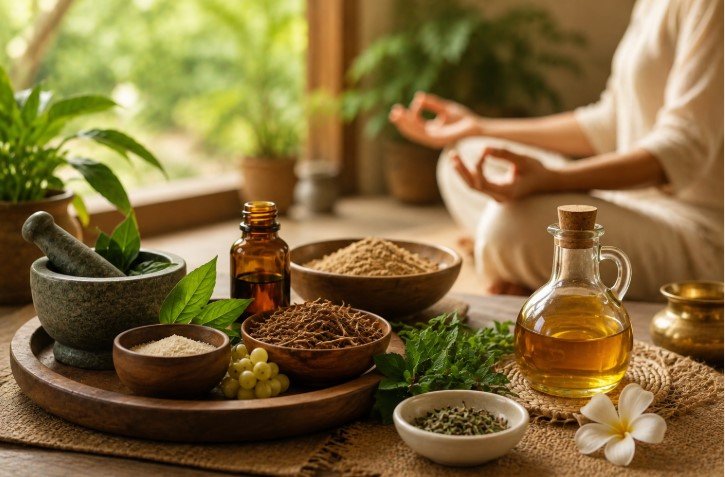
Alongside routine and diet, Ayurveda draws on herbs and rituals that have been used for generations to support a calmer nervous system.
Adaptogenic Herbs: Ashwagandha and Brahmi
Ashwagandha is one of the most studied Ayurvedic herbs for stress, traditionally used to support the body’s ability to adapt to pressure without becoming depleted. Brahmi is used more specifically for mental fatigue, memory, and an overactive mind. Both are usually introduced gradually and alongside routine changes, not as a stand-alone fix. For a closer look at how Ashwagandha supports stress and sleep, Advik Ayurveda has a detailed breakdown of how this adaptogen is traditionally used.
Aromatherapy and Calming Oils
Ayurveda has long paired scent with emotional regulation, using oils like lavender, sandalwood, and vetiver to calm an overactive nervous system before sleep or during high-stress periods. These are supportive tools, not medical treatments, but a consistent evening ritual using calming essential oils such as lavender makes it easier for many people to wind down after an overstimulating day.
Ayurvedic Practices for Emotional Regulation
Beyond herbs, Ayurveda relies heavily on physical practices that work directly on the nervous system.
Pranayama and Breath Control
Controlled breathing practices are used to shift the body out of a stress response fairly quickly. Slow, extended exhalation in particular is associated with calming the nervous system, and it needs no equipment or travel — making it one of the more realistic tools for people managing stress between time zones and back-to-back calls.
Abhyanga — Self-Massage as a Nervous System Reset
Warm oil self-massage, done regularly, is used in Ayurveda to ground an overactive Vata pattern and support deeper sleep. It is a simple ritual, but consistency matters more than intensity.
For a broader look at how these ideas connect with anxiety, distance, and family stress specifically, our full guide to mental health and anxiety for NRIs goes deeper into the emotional side of this experience.
For readers who would rather experience these practices in a structured setting than piece them together alone, MorningSun curates residential programs built around exactly this kind of recovery.
Where This Fits for NRIs and Foreigners Managing Stress From Abroad

Stress connected to India rarely stays purely emotional. It often mixes with the practical weight of managing aging parents from a distance, which can make ordinary anxiety feel heavier and harder to name. Ayurveda’s emphasis on daily rhythm is genuinely useful here, precisely because it does not require being physically present in India. Diet, sleep timing, breathing practices, and herbal support can all be adapted to a life abroad. What usually cannot be replicated from a distance is the deeper reset that comes from a structured retreat environment, which is why many NRIs choose to combine daily Ayurvedic habits at home with an occasional dedicated stress-recovery break in India.
When Ayurveda Should Work Alongside Professional Mental Health Care
Ayurveda is a supportive framework, not a replacement for clinical care. Persistent anxiety, panic attacks, depression, or thoughts of self-harm need professional attention, not only lifestyle correction. The World Health Organization notes that anxiety disorders respond well to structured psychological treatment, and that untreated anxiety tends to compound over time rather than resolve on its own. A responsible ayurveda approach to mental health treats herbs, routine, and breathing practices as complements to therapy or medical care when a condition is more serious, not as a substitute for it. If your own experience feels closer to a clinical concern than everyday stress, our mental health guidance for NRIs outlines when and how to seek that support.
Practical First Steps If You Want to Try This Approach
Ayurvedic mental wellness rarely starts with an elaborate program. It usually starts with three or four small, repeatable changes:
- Fix a consistent sleep and wake time, even on weekends.
- Move toward warm, regular meals instead of skipped or erratic eating.
- Add ten minutes of slow, extended-exhale breathing before bed.
- Introduce one herb or oil at a time, and give it a few weeks before judging results.
Once these basics feel steady, many people look toward a more immersive reset than daily habits alone can offer.
A Short Conclusion
Ayurveda does not promise to remove stress from an NRI life split across countries, time zones, and responsibilities. What it offers is a workable framework — routine, food, breath, and rest — for handling that stress with a steadier nervous system. Whether that starts with an earlier bedtime or a proper Ayurvedic retreat, the approach stays the same: treat the mind and body as one system, not two.
FAQs:
It treats mind and body as connected, addressing stress through routine, diet, herbs, and breathing.
Many people use Ayurvedic routines and herbs like ashwagandha to support calmer, more manageable anxiety.
No. Ayurveda supports lifestyle and routine; serious conditions still need professional mental health care.
Vata imbalance is most commonly linked to overthinking, restlessness, and disrupted sleep.
Most people notice gradual change over several weeks of consistent routine and herb use.