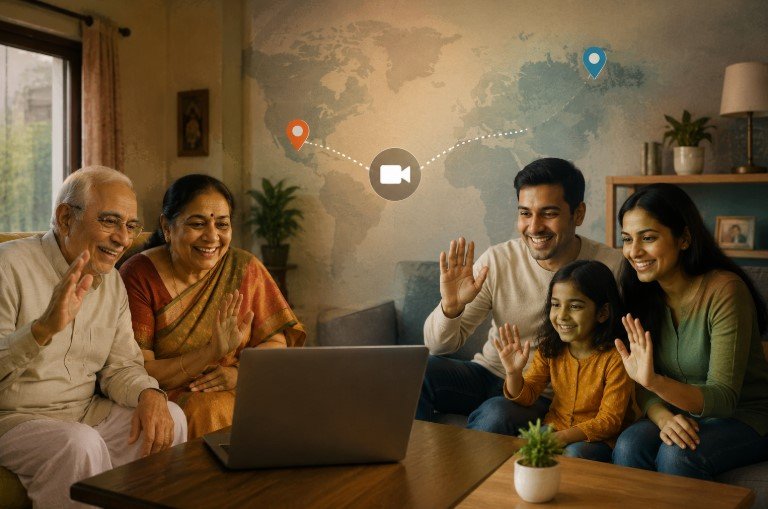
Grandparents on masala-doodh duty every winter. An aunt moving in for a month before a wedding. Three generations arguing over the remote in one living room. Not long ago, this was just how a lot of Indian households worked — one roof, many relatives, decisions made together over evening chai. Migration changes that picture fast. Once a family crosses an ocean for a job, a degree, or a better passport, the old floor plan of the joint family rarely survives in its original form. Rooms shrink to a two-bedroom rental. Grandparents stay behind or visit on a six-month tourist visa. A WhatsApp group becomes the new courtyard where everyone still gathers. This is not really a loss of culture. It is a redesign of it, built for a family spread across time zones instead of two floors of the same house.
What the Joint Family System Actually Meant
Before migration scattered everyone, a joint family was a working system, not just a living arrangement. Grandparents, parents, children, and often uncles and aunts shared one household, one kitchen, and one set of decisions. Childcare was distributed among whoever was free that day. Money was pooled for weddings, school fees, and emergencies, so no single person carried a bad year alone. Elders had a say in big choices — where to invest, who to marry, when to move house — and in return, they were looked after as they aged, without anyone drawing up a formal care plan for it. Festivals ran on autopilot because everyone already knew their job: who cooked, who decorated, who handled the guests.
None of this was perfect. Plenty of people grew up chafing against the lack of privacy, the weight of collective opinion on personal choices, or the expectation that individual plans always bent around family consensus. But the system did solve a set of very real problems: who watches the baby while a parent works, who sits with grandma at the hospital, who absorbs the cost when a business fails. Those problems do not disappear just because a family moves abroad. They just lose the structure that used to solve them automatically.
Why Migration Broke the Traditional Model
Visas, Jobs, and Small Apartments
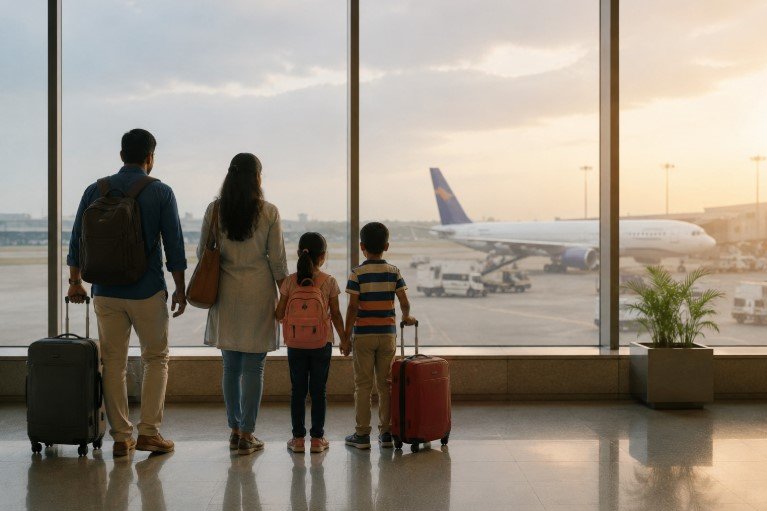
Work visas are built around one applicant, sometimes a spouse, rarely an extended family. A software engineer moving to Frankfurt or a nurse moving to Manchester is not bringing along in-laws and cousins on the same paperwork. Housing abroad is priced and built for small households — a one- or two-bedroom flat is standard, not a rambling family home with room to spare. Even families who want to live together often cannot, simply because visas, rent, and school catchment areas do not allow for it. The joint family does not fade abroad because people stop valuing it. It fades because the practical scaffolding — space, paperwork, proximity — is no longer there.
Distance Turns Duty Into Guilt
In the old model, looking after aging parents was a shared, physical job — someone was always nearby. Abroad, that duty gets outsourced to phone calls, money transfers, and the occasional flight home. Many NRIs describe a low hum of guilt that never fully goes away, the sense of paying for care instead of giving it directly. This tension shows up constantly in conversations around aging parents living far from their children, where families try to recreate old-model support using new-model tools: caregivers, telemedicine, and careful budgeting from thousands of miles away.
The New Shapes “Joint Family” Takes Abroad
The joint family has not disappeared among NRIs. It has split into a few new versions, each trying to solve the same old problems with different tools.
The Phone-and-Flight Family
This is the most common version today. Everyone lives apart — parents in India, children scattered across two or three countries — but stays connected through daily calls, shared photos, and a family WhatsApp group that never really sleeps. Big decisions still get discussed as a group, just over video instead of at the dinner table. Flights home during festivals or emergencies do the work that physical proximity used to do.
The One-Roof-Again Household
A smaller but growing group of NRIs sponsor a parent’s long-term visa and bring them into their home abroad, recreating a version of the joint family inside a Western suburb. This solves the caregiving and loneliness problem but creates new friction: different routines, different ideas about raising grandchildren across two cultures, and a parent who may feel isolated without their old social circle. It works well for some families and badly for others, largely depending on how openly everyone talks about expectations before the move, a topic closely linked to how NRI couples already negotiate two families’ expectations under one marriage.
The Festival-Season Family
Some families deliberately compress “joint family time” into short, intense windows — a wedding, Diwali, a summer trip — rather than trying to sustain it year-round. For a few weeks, cousins, grandparents, and parents share space again, almost like the old model, before scattering back to their separate lives. It is less continuous than the traditional joint family, but for many NRIs it is more realistic than pretending distance does not exist.
Curious how other NRI families are rewriting old traditions for new countries?
What Families Quietly Lose in the Shift
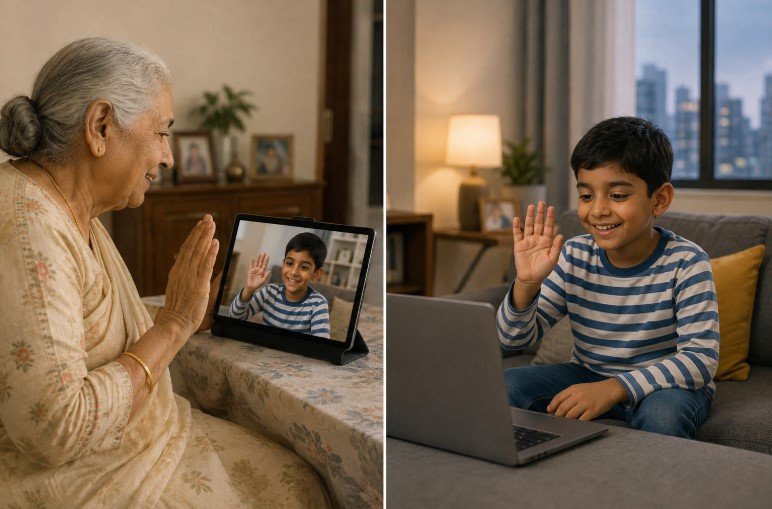
Some things do not translate well across a WhatsApp screen. Spontaneous, everyday contact — a grandmother teaching a child to cook without either of them planning it — is hard to replicate on a scheduled video call. Elders who were once central to decision-making can end up sidelined, consulted out of politeness rather than genuine need. Children may grow up fond of relatives they barely know, more familiar with their voices than their presence. And the informal safety net a joint family once provided — someone always available in a crisis — gets replaced by paid help, insurance, and careful contingency planning. None of this means NRI families love each other less. It means the structure that used to carry a lot of this weight automatically now needs to be rebuilt on purpose, which is exactly the challenge covered in guidance on raising emotionally grounded children abroad.
Managing an aging parent’s care from another country?
What NRI Families Are Rebuilding on Their Own Terms
Interestingly, a lot of NRI households are not trying to recreate the old joint family exactly. They are keeping the parts that still work and letting go of the parts that do not.
Grandparents’ remedies are one example. A lot of what used to pass informally between generations in a shared kitchen — a turmeric-milk fix for a cold, a specific oil for dry winter skin, a ubtan recipe used before every wedding — is now something families actively seek out and preserve, rather than absorbing it by accident. Brands rooted in these everyday household practices, like Advik Ayurveda’s natural skincare and haircare formulations, have found an audience specifically among NRIs trying to hold onto rituals their grandmothers once passed down in person.
Language and storytelling are another area of deliberate rebuilding. Families now schedule video calls specifically so grandparents can tell stories or teach a few words of a regional language, something that once happened naturally over an afternoon nap or a walk to the market. Planned trips back to India, timed around school holidays, have become the modern version of “going to the village every summer,” giving children concentrated exposure instead of daily immersion.
Money decisions, too, are handled with more explicit conversation than before. Where a joint family once pooled resources informally, NRI families now tend to set clearer boundaries around financial planning — who pays for a parent’s medical bills, a sibling’s wedding, a cousin’s education — precisely because the old informal system depended on daily proximity that no longer exists.
Want to bring a piece of that grandmother’s-kitchen ritual into your own home abroad?
Practical Ways to Keep the Joint Family Spirit Alive Abroad
Build a Rhythm, Not Just Random Calls
Ad hoc calls tend to fade over time. Families that stay close usually settle into a rhythm — a Sunday video call, a shared festival calendar, a family group where photos and small updates go daily. Rhythm does more for connection than length of conversation.
Talk About Money and Care Early
Waiting for a health emergency to discuss who pays for what, or who flies home first, adds panic to an already stressful moment. Families that talk about eldercare, inheritance, and financial responsibility while everyone is healthy tend to handle crises with far less conflict.
Plan Reunions With Intention
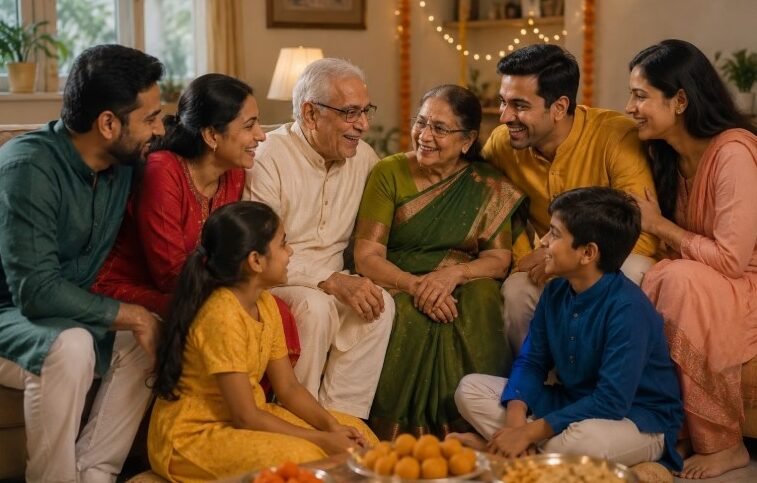
Because time together is limited, it helps to treat reunions as more than a visit. Some NRI families now build entire trips around reconnecting generations in one place — a joint family holiday, a wellness break with grandparents, or a heritage trip for grandchildren who have never really lived in India. Options built specifically for this kind of multi-generational reconnection, such as family wellness experiences in India, are becoming a practical way to recreate joint family closeness in a condensed, well-organised window rather than leaving it to chance.
Planning a trip to reconnect the whole family in India?
Give Elders a Real Role, Not a Ceremonial One
Video calls make it easy to reduce grandparents to well-wishers on birthdays. Families that keep the joint family spirit alive tend to actively ask elders for opinions on real decisions — a child’s school, a career move, a wedding date — even from a distance, so they stay involved rather than sidelined.
Let Siblings Split Responsibility Openly
When one sibling lives near aging parents and another lives abroad, resentment builds quietly if roles are never spoken about. Splitting duties on purpose — one person handles finances, another handles medical appointments, a third plans the yearly visit — mirrors how a joint family once divided labour, just with video calls standing in for a shared kitchen table.
A Short Word on Where This Is Headed
The joint family system NRI diaspora communities grew up with is not vanishing. It is splitting into smaller, more deliberate pieces — a phone call here, a sponsored visa there, a carefully planned summer trip, a jar of homemade achaar carried through customs. None of these fully replace three generations under one roof. Together, though, they are keeping the same basic promise the joint family always made: that no one in the family is really alone, wherever they happen to be living.
FAQs:
No, it is changing shape — becoming digital, occasional, and more intentional rather than disappearing.
Because caregiving shifts from physical presence to phone calls, money, and occasional visits.
Not automatically. Values often survive through active effort, not proximity alone.
Scheduled calls, family group chats, and planned reunions during festivals or holidays.
It depends on the family. Discuss expectations and routines honestly before deciding.
External Resources
Ministry of External Affairs, Government of India — Population of Overseas Indians: mea.gov.in/population-of-overseas-indians
Pew Research Center — Global migration and family research: pewresearch.org – Migration & Immigration