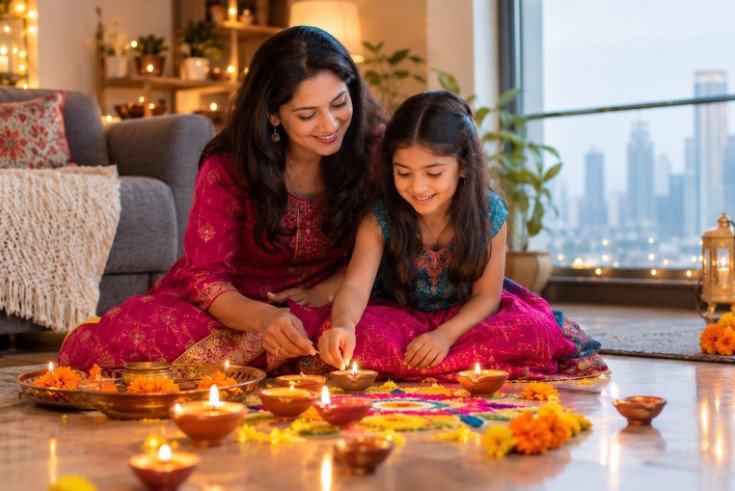
Your child asks why grandma is lighting little clay lamps on the balcony of a flat in Ohio. Or why you’re covered in coloured powder on a Tuesday. Or why everyone at the gurdwara is crying and laughing at the same time. These are fair questions. Festivals abroad rarely come with the classroom, the cousins, or the week off school that made them make sense back home. So the job of explaining Indian festivals to kids abroad falls almost entirely on parents — and it’s a job worth doing well, because a festival a child understands is one they’ll keep celebrating long after they’ve moved out.
Why Festivals Feel Different When You’re Far From Home
In India, a festival explains itself. The whole street smells like it, the shops are decorated for it, and school lets out because of it. Abroad, none of that scaffolding exists. Diwali falls on a random Thursday. Holi means one day of colour instead of a whole town turning into a canvas. Without the surrounding noise, a festival can shrink down to just a ritual — something you do because your parents told you to, not something you understand.
That gap is exactly why teaching festival significance to NRI kids matters more abroad than it ever did in India. A child who only sees the outer form — lamps, sweets, colours — without the reason behind it tends to treat the festival as a chore by the time they’re teenagers. A child who knows the story usually keeps coming back to it, even as adults, even from far away.
Start With the Story, Not the Rulebook
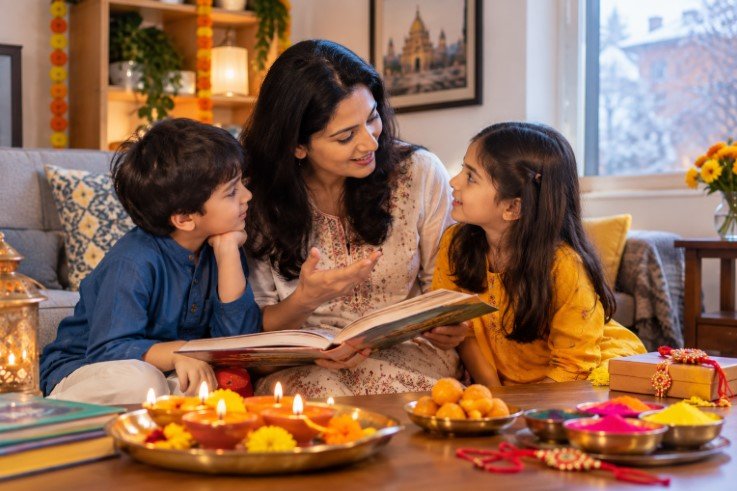
Kids don’t remember instructions. They remember stories. Before you explain what to do during a festival, explain why it exists at all.
Diwali is about light winning over fear
Skip the long genealogy of Ramayana characters at first. Tell a five-year-old that Diwali is the day everyone lights lamps to welcome someone home after a very long, very hard journey — and that lighting a lamp is a way of saying “you made it, and we’re proud of you.” That single idea (coming home, being welcomed, good beating something scary) is something a child in London or Toronto understands instantly, even before they learn the names Rama and Sita.
Holi is about starting fresh, not just colour
Most foreign-born kids think Holi is just a colour fight, which is honestly a fine place to start. But add one layer: Holi marks the end of winter and the start of a new season, and throwing colour on someone — even someone you don’t know well — is an old way of saying old grudges don’t matter today. That’s a useful idea for any classroom, in any country.
Raksha Bandhan is about a promise, not just a thread
A thread tied on a wrist means nothing to a child raised outside India unless you explain the promise underneath it: a sibling promising to look out for another, no matter how far apart they live. Frame it as a promise, not a craft project, and it sticks.
Turn Festivals Into Something Kids Can Feel
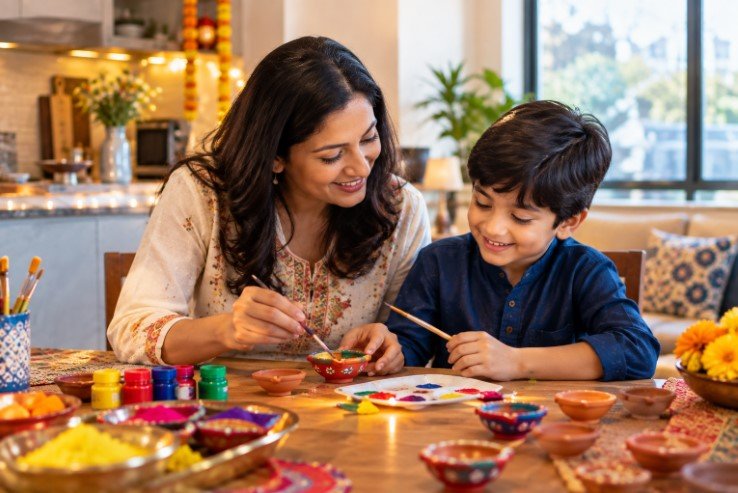
Children learn culture through their senses long before they learn it through explanation. If a festival abroad is under-resourced anywhere, it’s usually here.
Let them hear it
Play the actual bhajans, dhol beats, or Lohri folk songs in the car on the way to school that week, not just at the event itself. Repetition outside the “official” celebration is what turns a sound into a memory.
Let them taste it
Let kids help make one sweet, even badly. A child who has rolled laddoos with sticky hands remembers Diwali completely differently from a child who was just handed one on a plate.
Let them touch it
Small, hands-on crafts do more work than any lecture. Painting a clay diya the way it’s traditionally shaped and coloured back home, or trying a simple rangoli pattern on paper before graduating to actual rice flour on the floor, gives a child something to point at and say, “I made this for Diwali.”
Make Getting Ready Part of the Magic
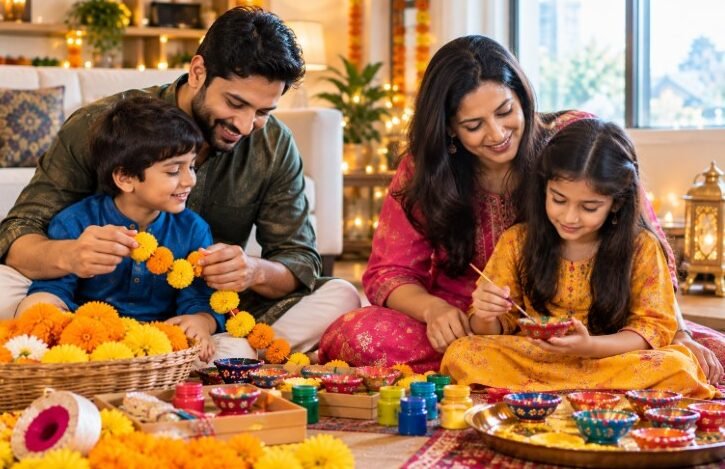
In India, the run-up to a festival is half the fun — new clothes, oil baths, house cleaning, everyone a little more excited by the day. Abroad, this prep phase often gets skipped entirely because there’s school the next morning. Bring even a small version of it back.
A weekend ubtan or oil-massage ritual before Diwali, using something gentle and natural like a kesar ubtan or onion hair oil from Advik Ayurveda, turns “getting ready” into its own small tradition rather than a rushed shower before guests arrive. It also gives you ten quiet minutes to tell the story again while you’re at it — kids absorb far more during a slow head massage than during a lecture at the dinner table.
New clothes matter too, and they don’t need to be expensive to be meaningful. Choosing something in a handloom fabric and explaining which region it’s from turns a shopping trip into a small geography lesson your child will actually enjoy.
Build a Festival Calendar Your Kids Can Look Forward To
Uncertainty is the enemy of excitement. If a child doesn’t know a festival is coming, they can’t look forward to it. Put up a simple year-round calendar — on the fridge, on a shared family app, wherever it’ll actually get looked at — marking Diwali, Holi, Raksha Bandhan, Navratri, Eid, Christmas if your family celebrates it, and any regional festival specific to your family’s state. Let your child cross off the days. This one habit does more for Indian culture education abroad than almost anything else on this list, because it turns festivals from surprises into things a child actively counts down to.
If you want the stories and the everyday rituals behind each date already written out for you, keep a running list of past write-ups bookmarked so you’re never caught explaining a festival from memory alone.
Answer the Hard Questions Honestly
Kids abroad ask sharper questions than kids in India do, mostly because they’re comparing everything to what their classmates celebrate. “Why do we worship a statue?” “Why do we throw colour at strangers?” “Why does grandma cry during Raksha Bandhan?” Don’t dodge these with “because we’re Indian” — that answer teaches a child that culture is an obligation, not something with its own logic.
Try instead: “The statue isn’t the point — it’s a way of focusing our attention while we say thank you, the same way people light candles in a church or face a direction to pray.” Comparisons to festivals or customs your child already sees around them (school holidays, birthday traditions, national days) make Indian festivals feel like one more valid way of celebrating, not a strange exception.
For the historical and religious background you might not remember every detail of yourself, India’s Ministry of Culture keeps some of this documented plainly — Durga Puja in Kolkata, for instance, was recognised by UNESCO as part of humanity’s intangible cultural heritage, which is a genuinely good, factual answer for a curious ten-year-old who wants to know if this is a “real” tradition or just a family thing.
Give the Story Somewhere to Go
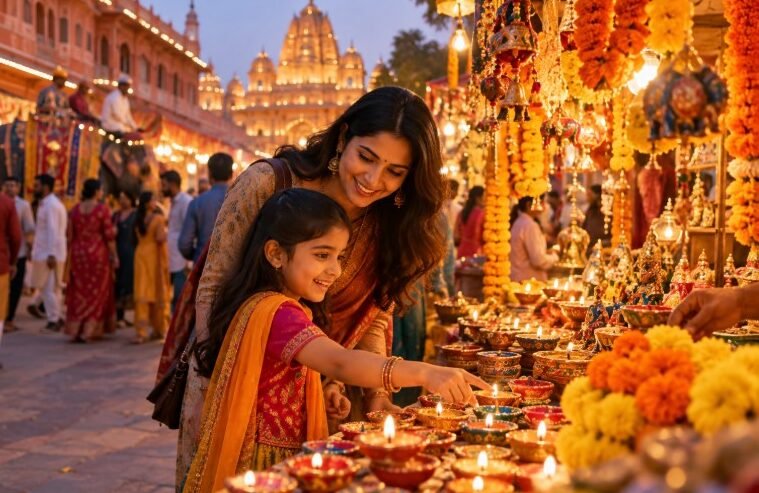
Explaining a festival over video call only goes so far. At some point, the most effective lesson is standing in the middle of it — a Diwali market in Jaipur, a Holi celebration in Mathura, a family kitchen in Kerala during Onam. If a trip back to India is on the horizon, plan it around a festival on purpose rather than around whichever school break happens to line up.
A trip built around food, temples, and family time does more for a child’s sense of identity than a trip built around sightseeing alone. If you’re planning that kind of visit, a guided culinary tour of India timed around a festival lets kids taste the food behind the stories they’ve already heard, region by region.
For families who want to combine that cultural side with some rest and reset for the parents too — long-haul flights and jet lag are real — a family wellness trip to India can pair temple visits and festival travel with a slower, more restorative pace for everyone, not just the kids.
A Short List for Busy Parents
If the sections above feel like a lot, here’s the shortest version that still works:
- Tell the story behind the festival before you explain the ritual.
- Use sound, taste, and touch — not just a one-day event — to make it memorable.
- Keep a visible festival calendar so kids can look forward to it.
- Answer hard questions honestly, using comparisons kids already understand.
- Where you can, close the loop with a real trip to India timed around a festival.
None of this needs to be perfect. A child doesn’t need a flawless retelling of the Ramayana or a picture-perfect rangoli. They need a parent who seems to genuinely care about the story — because that’s the part they’ll actually copy.
FAQs:
Never too young. Even toddlers absorb tone, sound, and repetition well before they understand words.
Invite a classmate to join in once. Curiosity usually beats embarrassment fast.
Yes, briefly. Kids can hold culture and belief as separate, connected ideas.
Learn alongside your child. Admitting “let’s find out together” builds trust, not doubt.
Give them a real role — cooking, hosting, or telling the story to younger cousins.
Yes. Blending shows kids identity can be layered, not either-or.
External Resources
UNESCO’s decision inscribing Durga Puja in Kolkata as Intangible Cultural Heritage
Vikaspedia’s children’s corner on India’s festival (Utsav) portal
Ministry of Tourism, Government of India — Incredible India culture pages