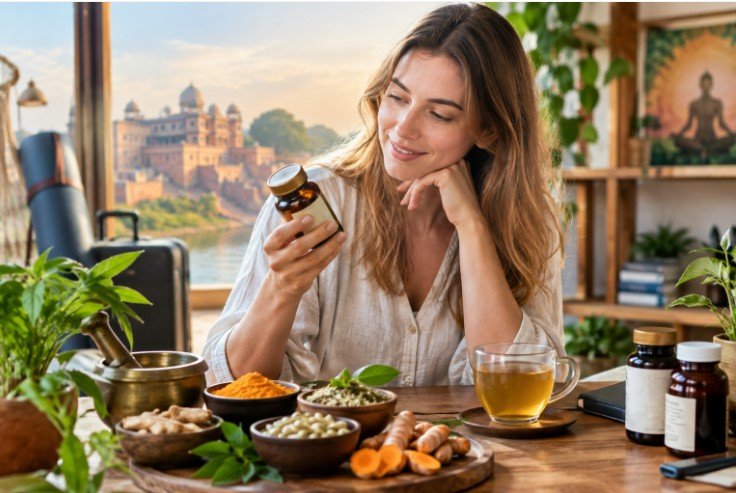
A decade ago, most people outside India had never heard of ashwagandha. Today it sits on pharmacy shelves next to melatonin and magnesium in London, Toronto, and Sydney. Turmeric lattes now appear on ordinary café menus. Wellness apps offer “dosha quizzes” right alongside sleep trackers. Ayurveda popularity in the west is not a passing curiosity anymore. It is a visible shift in how millions of people outside India think about health, food, and daily routine.
For NRIs and global Indians, this can feel strange to watch. Something that grew up in a grandmother’s kitchen — turmeric milk for a cold, warm oil before a bath — is now sold abroad as a wellness discovery. This article looks at what is actually driving global interest in ayurveda, what the trend gets right, what it oversimplifies, and how to make sense of it if you are watching from outside India.
What Ayurveda Popularity in the West Actually Looks Like
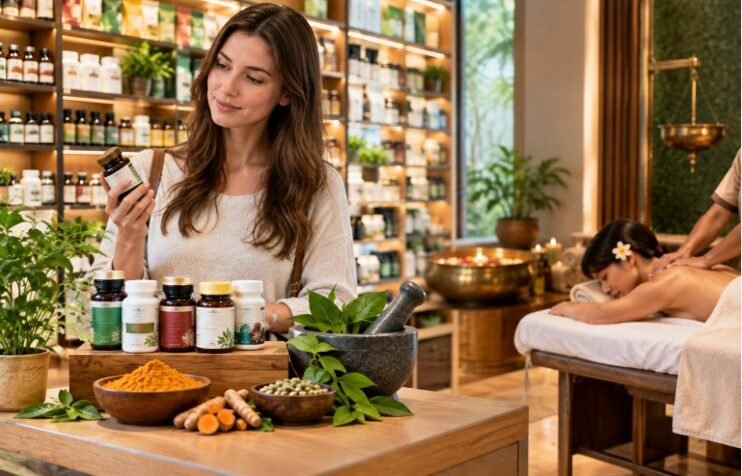
The interest is not limited to yoga studios anymore. It shows up in supermarkets, dermatology clinics, corporate wellness programs, and even hospital gift shops in some cities.
From Supplement Aisles to Spa Menus
Walk into a health food store in most Western cities and you will likely find ashwagandha capsules, triphala powder, and neem-based skin products sitting next to standard vitamins. Hotel spas from California to the Cotswolds now offer Abhyanga oil massage and Shirodhara as premium treatments, often priced higher than a standard Swedish massage.
This is a real shift from ten years ago, when Ayurveda was mostly confined to Indian grocery stores and a small number of specialty wellness centers.
Ayurvedic Words Entering Everyday Wellness Vocabulary
Terms like dosha, pitta, vata, kapha, and ojas now appear in mainstream wellness content, sometimes stripped of their original context. Podcasts explain “your dosha type” the way astrology apps explain star signs. Panchakarma, once a specific, supervised clinical process, is now used loosely to describe almost any multi-day detox program.
The vocabulary has crossed over even where the full framework behind it has not.
Why Western Interest in Ayurveda Is Growing Right Now

Several forces are pushing this trend at the same time, which is partly why it can feel sudden.
Burnout Is Pushing People Toward Slower Systems
Many Western health systems are built around treating illness after it appears, not preventing it. As chronic stress, poor sleep, and lifestyle-related fatigue have become more common, people are looking for frameworks that address daily routine, not only diagnosis and prescription. Ayurveda’s focus on sleep timing, food combinations, and seasonal adjustment fits neatly into that gap.
Frustration With Symptom-Only Healthcare
A growing number of patients feel unheard in short medical appointments that treat one symptom at a time. Ayurveda’s consultation style — asking about digestion, sleep, mood, and daily habits together — feels more personal, even when the science behind specific claims is still limited. DeshSansaar’s own guide to exploring Ayurveda in India covers this exact gap between expectation and evidence in more detail.
Social Media Made Ancient Concepts Shareable
Short-form video turned complex ideas into thirty-second explanations. Oil pulling, tongue scraping, and seed cycling spread fast because they are visual, low-cost, and easy to try at home. Whether or not every claim is well-supported, the format made ancient routines feel approachable overnight.
The Institutional Side of the Ayurveda Trend Abroad

This is not only a social media story. Formal health institutions are involved too, and that gives the trend more staying power than a typical wellness fad.
Global Health Bodies Are Paying Attention
The World Health Organization’s work on traditional, complementary, and integrative medicine has expanded in recent years, recognizing that a large share of the world’s population already uses some form of it alongside conventional care. As part of that push, WHO established its Global Traditional Medicine Centre in Jamnagar, Gujarat — the first center of its kind anywhere in the world, with a mandate to study evidence, safety, and standards across traditional systems, including Ayurveda.
That kind of institutional backing signals something different from a passing consumer fad.
Research Bodies Are Studying It Cautiously
In the United States, the National Center for Complementary and Integrative Health, part of the National Institutes of Health, has funded and reviewed clinical studies on Ayurvedic approaches for conditions like osteoarthritis and rheumatoid arthritis. Its published position stays careful: some approaches show promise, but evidence remains limited compared to conventional treatments, and quality control on imported herbal products is a genuine concern.
This mix of real interest and real caution is a more accurate picture of the science than either wellness marketing or blanket dismissal suggests.
From Curiosity to Lifestyle: The Ayurveda Trend Abroad Is Evolving

What started as isolated ingredient interest is turning into broader lifestyle adoption in some circles.
Skincare and Haircare Are the Easiest Entry Point
For many Western consumers, skincare is the lowest-risk way to try Ayurveda. Ingredients like aloe vera, onion oil, mulethi, and neem have moved from niche Indian brands into mainstream beauty conversations, partly because they are marketed as “clean” and “toxin-free” rather than medicinal. Ayurveda-rooted skincare brands such as Advik Ayurveda have built entire product lines around this exact shift — natural formulations explained through traditional ingredient logic rather than trend language.
This is often where a curious Western customer starts, long before they consider a full consultation or a dietary change.
Curious what Ayurvedic skincare actually looks like in practice?
Wellness Travel Is Bringing Westerners to India
The second major entry point is travel. Kerala, Rishikesh, and parts of Goa have become established destinations for Westerners seeking supervised Panchakarma and detox programs, not just yoga holidays. Verified Ayurveda retreats in India now market directly to international patients who want a structured, multi-day program rather than a single spa treatment.
This is where the trend moves from casual interest to a genuine health decision — and where research into the actual clinic or retreat matters far more than a glossy brochure.
Curious why so many international patients specifically choose India for this kind of care?
Why Western Adoption of Ayurveda Isn’t the Same as Practicing It in India

It is worth being honest about a gap here. Ayurveda, as practiced in India, is a full diagnostic system built around individual constitution, detailed consultation, and long-term observation. What often reaches Western shelves is a single herb, isolated from that framework and sold as a standalone solution.
This does not make the ingredient useless. It does mean the packaging often overpromises. A bottle of ashwagandha capsules is not the same as a structured Ayurvedic consultation, and a weekend detox retreat is not automatically equivalent to a properly supervised Panchakarma program.
Quality control adds another layer of risk. Herbal products sold internationally are not always tested for contamination, and practitioner credentials vary widely outside India, since most Western countries do not license Ayurvedic practitioners the way they license doctors. DeshSansaar’s Ayurveda guidance for NRIs and foreigners walks through exactly these safety questions for anyone evaluating treatment in India itself, which is worth reading before making decisions based on a trend alone.
What This Trend Means for NRIs and Global Indians
If you grew up with Ayurveda as ordinary household knowledge, watching it become a trend abroad can bring mixed feelings — pride, but also mild frustration at how much gets simplified or repackaged along the way.
There is also an opportunity here. Many NRIs already use practical, low-risk Ayurvedic routines, from simple seasonal immunity habits to travel recovery tips for long-haul flights. If friends or colleagues abroad ask about Ayurveda because of something they saw online, that is a natural moment to share something more grounded than a supplement advertisement.
This is also a good time to revisit your own understanding. Whether it is how Ayurveda approaches everyday stress and mental strain, or simple seasonal routines your family always followed without naming them ritucharya, there is often more structure behind old habits than people realize until they look closer.
How to Evaluate Ayurveda Claims You Come Across Abroad
Not every claim you see online or in a store deserves equal trust. A few questions help filter genuine information from marketing:
- Does the source explain limitations, or only benefits?
- Is the practitioner or brand transparent about credentials and sourcing?
- Are there guaranteed cure claims, especially for serious conditions?
- Is the price tied to urgency or fear rather than a clear treatment plan?
- Does it acknowledge when conventional medical care is still necessary?
A responsible source, whether it is a retreat, a skincare brand, or a written guide, should be comfortable answering all five questions honestly. For a deeper framework on evaluating Ayurveda claims specifically around treatment in India, DeshSansaar’s dedicated Ayurveda guidance page breaks this down step by step.
Want the full framework before you trust any Ayurveda claim you see abroad?
Final Thoughts
Ayurveda popularity in the west is built on something real: growing frustration with reactive healthcare, genuine curiosity about older systems, and now, institutional research trying to separate evidence from hype. At the same time, western adoption of ayurveda is still maturing. Much of what reaches store shelves is simplified, and not every retreat or product lives up to its marketing.
For NRIs and global Indians, this trend is a chance to bring more clarity to a subject you likely understand better than most people asking about it online. Whether someone abroad is curious about a skincare ingredient, a retreat in Kerala, or how Ayurveda fits alongside modern medicine, the honest answer is usually more useful than the trending one.
Have a specific question about exploring Ayurveda in India?
FAQs:
Burnout, distrust of quick-fix healthcare, and viral wellness content are driving global interest in Ayurveda.
Not exactly. Western versions are often single herbs, missing India’s full diagnostic and consultation framework.
No. Most countries treat them as supplements, not medicines, so quality control varies widely.
No. It can support lifestyle and prevention, but serious conditions still need proper medical care.
Check WHO resources, NCCIH publications, and India-specific guides before booking any Ayurveda program.
Partially. Some studies show promise, but overall evidence remains limited compared to conventional medicine.