
For NRI and global Indian families, distance can change how grandparents and grandchildren know each other. A child may grow up in the United States, Canada, the UK, Australia, the Gulf, or another country while grandparents remain in India. They may meet during annual visits, holidays, or weddings, yet still feel that something is missing between those visits.
The good news is that closeness does not depend only on living in the same home. Connecting grandparents grandchildren across borders works best when contact becomes regular, personal, and easy for both generations. A five-minute conversation about a school project can matter more than a long call that happens only once a month.
This guide shares practical NRI family bonding tips for families who want to make distance feel smaller without turning family communication into another obligation.
Why cross-border grandparent relationships need a different approach
Distance removes many ordinary moments. Grandparents cannot always watch a grandchild leave for school, hear about a small achievement at dinner, or help with a weekend activity. Grandchildren may also know grandparents mainly through occasional visits and formal video calls.
That can create a relationship built around updates rather than shared life.
UNICEF notes that grandparents can play an important role in children’s sense of belonging, particularly through stories and family history. For families living across countries, those same stories can become a bridge between generations.
The goal is not to recreate an Indian household abroad. It is to create a relationship that feels natural to both sides.
1. Make video calls predictable, not occasional
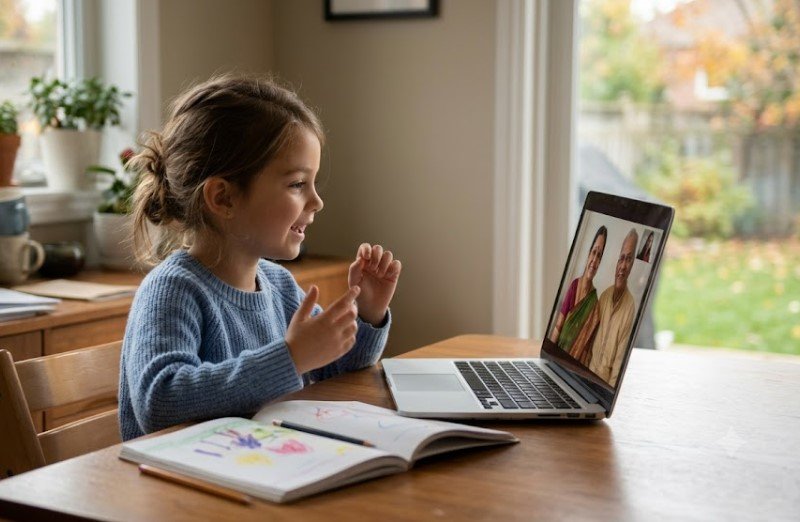
Video calls grandparents use can become much more meaningful when they happen at a predictable time. A fixed weekly call is often easier to maintain than repeatedly asking, “When are you free?” Choose a time that works for both time zones. Keep the first few calls short if a child is young. A 10–15 minute conversation can be enough.
Instead of making every call a question-and-answer session, give each call a simple theme: show one thing from the week; read a short story together; talk about a school activity; look at an old family photograph; cook the same simple dish from two kitchens; let the grandchild teach a game or new word; or ask grandparents to share something from their childhood.
The important point is continuity. Children remember repeated rituals.
2. Give grandparents a role in everyday life
A common mistake is making grandparents feel like visitors who appear only on special occasions. Children usually bond more strongly when relatives have a role in ordinary life.
Grandparents can help with small, low-pressure activities. They can listen to a child read, tell a bedtime story, teach a family recipe, explain an old photograph, or help with a simple craft.
If the child is learning a language, a grandparent can become a friendly conversation partner rather than a formal teacher.
This also works in reverse. Grandchildren can show grandparents how to use a new app, explain a favourite game, or share photos from school and weekend activities. The relationship becomes two-way. Both generations have something to teach and something to learn.
3. Use stories to preserve family memory
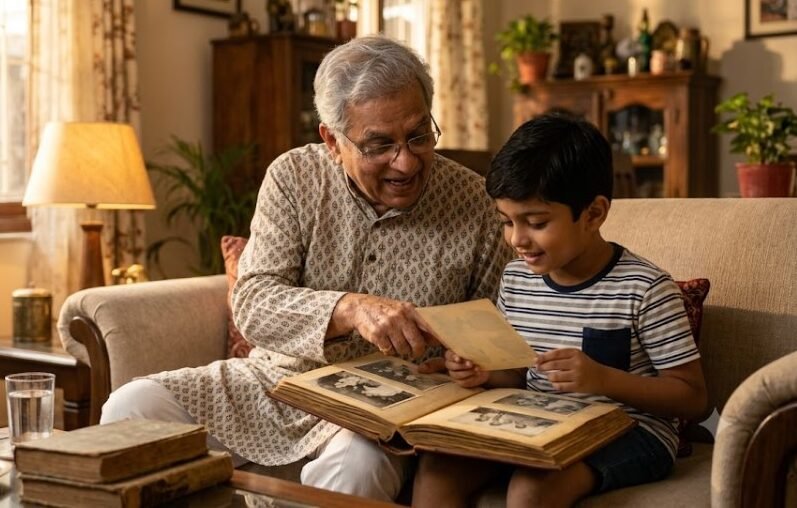
Family stories are one of the easiest ways to connect generations. Grandparents often carry memories that children cannot get from photographs or documents.
Ask them to tell stories about their first job, school days, how the family lived when they were young, a festival they remember, a favourite childhood meal, how a family tradition began, or a difficult period the family overcame.
Do not turn these conversations into history lessons. Let the child ask questions.
You can also record short audio or video stories, with the family’s consent, and organize them in a private family folder. Older children can help label the recordings by person, year, or topic. This creates a family archive that can be revisited later.
For more practical guidance on children growing up between cultures, see DeshSansaar’s guide to cultural identity for children growing up abroad.
4. Make language a relationship, not a test
Language can strongly affect how grandparents and grandchildren communicate. A grandparent may be most comfortable in Hindi, Bengali, Tamil, Punjabi, Gujarati, Malayalam, Telugu, or another Indian language, while a grandchild may prefer English or the local language.
Do not make fluency the price of affection.
Start with a few words that have emotional value: family nicknames, greetings, food names, blessings, jokes, or phrases used at home. Grandparents can introduce one expression during each call.
Parents can also provide a simple translation when needed. The aim is understanding, not perfect grammar.
This approach is especially useful for NRI families whose children are growing up with more than one cultural influence. DeshSansaar’s resources on language and roots can help families think about cultural continuity without turning it into pressure.
5. Create shared activities instead of only talking
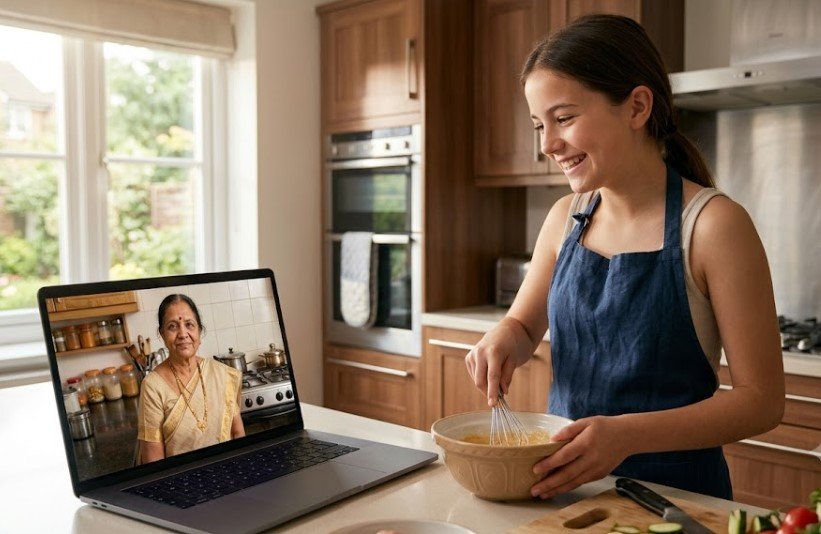
Some children find direct conversation difficult, especially on a screen. Shared activities can reduce that pressure.
Try drawing the same picture together, playing a simple guessing game, solving a puzzle, cooking the same recipe, looking through a family photo album, watching a short child-friendly video and discussing it, doing a simple exercise or stretching session, or building something with blocks or craft materials.
For older grandchildren, shared activities can be more age-appropriate. They might discuss a film, compare music, review photographs, or interview grandparents about a family event.
6. Respect time zones and energy levels
Cross-border family communication becomes difficult when one side always has to adjust.
Grandparents may wake early, take afternoon rests, or have medical appointments. Children may have school, homework, sports, or different sleep schedules. A call that is convenient for one household may be exhausting for another.
Create a shared family calendar with two or three suitable time windows. Keep backup options for busy weeks.
Also remember that older adults may tire faster during long video calls. A shorter call with attention and warmth is usually better than a long call where everyone is distracted.
For families managing wider aging-related responsibilities in India, DeshSansaar’s aging and chronic care guide explains why remote family support can become emotionally and practically demanding.
7. Build small rituals around festivals and milestones
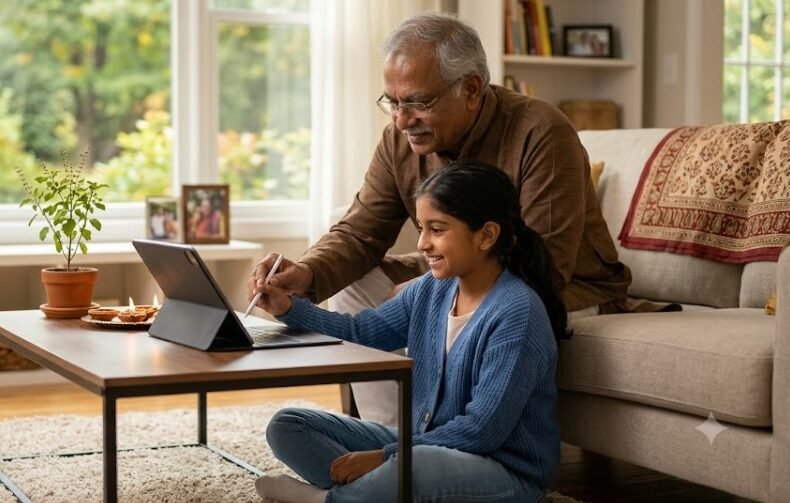
Festivals, birthdays, school achievements, first days, graduations, and family celebrations create natural reasons to connect. But rituals do not need to be elaborate.
A family could light a lamp together during a festival, share the same traditional recipe, exchange handwritten notes, ask grandparents to explain one festival memory, have a birthday call before the party, take the same family photograph during an annual visit, or create a yearly “grandparents and grandchildren” video.
These repeated moments create continuity. Children begin to associate grandparents with experiences, not just screens.
8. Make grandparents part of the child’s world abroad
Maintaining family ties abroad is easier when grandparents understand the child’s current environment.
Share school projects, local celebrations, sports, hobbies, pets, favourite foods, and friends’ activities when appropriate. Grandparents do not need to understand every detail. They simply need enough context to ask relevant questions.
Likewise, children should learn about grandparents’ daily lives in India. What does their morning look like? What grows in their garden? Which neighbour do they meet? What local place do they enjoy visiting? This exchange prevents both sides from becoming abstract figures in each other’s lives.
9. Let grandparents and grandchildren communicate without parents controlling every conversation
Parents naturally want to protect children and keep conversations on track. But some private space can help relationships grow.
For older children, allow a few minutes when they can talk directly with grandparents. They may discuss things they would not say in a group call.
Grandparents should also respect the child’s boundaries. A child may not want to answer questions about marks, appearance, food, friendships, or future plans every time.
The strongest cross-border relationships are built on curiosity, patience, humour, and trust.
11. Use technology thoughtfully
Technology is useful, but more technology does not automatically mean more connection. Choose tools that grandparents can use comfortably, keep notifications simple, and avoid changing platforms frequently.
For some families, a shared private album works well. Others may prefer voice messages because they are easier than video calls. A grandparent can send a short morning message, while a grandchild can send a photo after school.
The World Health Organization recognizes high-quality social connections as important for physical and mental well-being and notes that digital interventions can be part of efforts to reduce social isolation among older people.
For a practical wellness perspective on stress and daily balance, see this Ayurvedic stress and skin guide from Advik Ayurveda.
12. Keep the relationship flexible as children grow
A five-year-old and a fifteen-year-old will not connect with grandparents in the same way.
Young children may enjoy stories, songs, drawing, and games. School-age children may prefer demonstrations, jokes, cooking, and family stories. Teenagers may respond better to short messages, shared interests, music, sports, or one-to-one conversations.
Grandparents should not expect the same communication pattern every year.
Parents can help by updating grandparents about the child’s interests. Grandparents can then ask better questions and avoid conversations that feel repetitive.
A simple monthly family connection plan
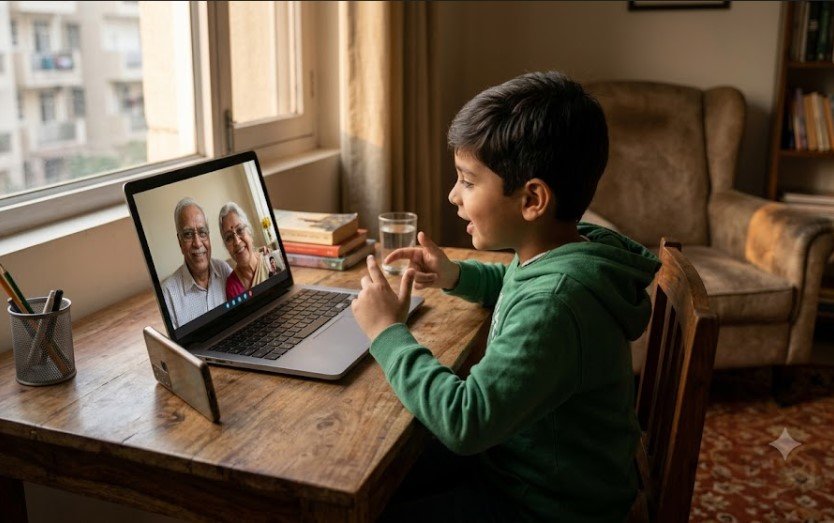
Families often struggle because everyone agrees that connection matters but nobody owns the routine. A simple monthly structure can help.
- Week 1: A short video call with a shared activity.
- Week 2: Exchange photos or voice messages from everyday life.
- Week 3: A family story or childhood memory from grandparents.
- Week 4: A longer call, game, recipe session, or virtual celebration.
What parents should avoid
Cross-border family bonding becomes harder when communication turns into pressure.
- Forcing children to stay on a call when they are tired.
- Making every call about school performance.
- Criticizing a child’s language ability.
- Comparing the child with cousins.
- Making grandparents feel guilty for not understanding technology.
- Making children feel guilty about living abroad.
- Using family culture as a source of fear or obligation.
- Treating every visit as a cultural correction session.
Connection grows when children associate grandparents with safety, warmth, humour, stories, and acceptance.
How grandparents can make calls more enjoyable
Grandparents do not need to become technology experts. Ask open questions, remember details from previous calls, show interest in the child’s hobbies, tell short stories, let the child teach something, and keep criticism out of routine calls.
A note for families supporting older grandparents
If grandparents are aging, connection may need additional planning. Hearing difficulties, vision changes, memory problems, mobility limitations, or fatigue can make digital communication harder.
Use larger screens, better lighting, headphones, captions, or simpler devices when useful. Keep the interface familiar. If video is tiring, switch to voice calls.
Connection should adapt to the person’s abilities rather than expecting the older adult to adapt to technology.
MorningSun’s family wellness resources can also be useful for families looking at shared routines, emotional wellbeing, sleep, and healthy habits across age groups.
For families interested in how shared routines can support family wellbeing, MorningSun’s personalised wellness programs provide a broader wellness perspective.
Why this matters beyond one family
A grandparent-grandchild relationship can carry family memory, language, values, humour, and identity across borders. It gives children a personal connection to relatives they might otherwise know only through photographs.
For grandparents, regular contact can create a meaningful role in a child’s life even when geography prevents daily involvement.
Conclusion
Connecting grandparents grandchildren across borders does not require perfect technology or long conversations. It requires consistency, shared experiences, respect for different ages, and genuine curiosity.
A weekly call, a family story, a shared recipe, a voice message, or a short video can become part of a child’s sense of family. Over time, these small rituals create familiarity.
For NRI families, the most useful approach is simple: make connection regular, make it enjoyable, and allow it to change as children and grandparents grow.
FAQs:
Once a week is a practical starting point, but frequency should suit both households.
Try voice messages, games, storytelling, shared activities, or shorter calls.
Discuss hobbies, music, sports, films, studies, technology, or topics the teenager chooses.
Choose two or three recurring time windows that work for both generations.
No. Encourage language through enjoyable conversations rather than pressure or correction.
Tell stories, play games, share memories, ask questions, or learn something from the child.
No. Digital contact supports continuity, while in-person visits create different shared experiences.
Record short stories with consent and store them in a private family archive.
Use simple devices, larger screens, familiar apps, and brief practice sessions.
Keep calls relaxed, avoid criticism, respect boundaries, and focus on shared interests