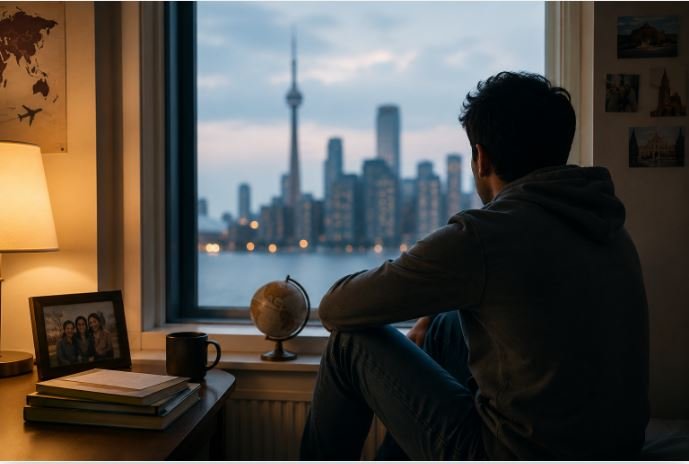
It doesn’t usually hit during the big moments. It hits on an ordinary Tuesday, standing in a supermarket aisle abroad, staring at a shelf of something that almost looks like the snack you grew up on but isn’t quite right. Or during a video call where everyone at the family dinner table back home is laughing at something you weren’t there to hear the beginning of.
Coping with homesickness as an NRI isn’t really about missing a place on a map. It’s about missing a version of belonging that doesn’t require explanation — where the food, the language, the humour, and the unspoken rules of a room all just make sense without effort. That kind of belonging is hard to recreate anywhere else, and pretending it doesn’t matter usually makes the feeling worse, not better.
This isn’t a piece telling you to be grateful for the opportunity and get over it. It’s a look at why this particular kind of homesickness is so persistent, what actually helps versus what just sounds helpful, and when it’s worth treating it as more than an ordinary bout of missing home.
Homesickness Doesn’t Mean You Made the Wrong Choice
One of the quieter struggles NRIs describe isn’t the homesickness itself — it’s the guilt attached to feeling it. Moving abroad was often a deliberate, hard-won choice: a better job, a degree, a life for your kids that felt out of reach at home. Missing India can feel like it’s somehow ungrateful, or like proof the decision was wrong.
It isn’t. Missing a place doesn’t cancel out the reasons you left it, and it doesn’t mean the life you’ve built abroad is any less real or worthwhile.

Coping With Homesickness as an NRI: Why It Hits Differently for This Group
Coping with homesickness as an NRI carries a few layers that don’t always apply to other kinds of relocation. It’s not just distance from a country — it’s distance from a specific role within a family and community that doesn’t easily translate elsewhere.
- Missing life events in real time — weddings, illnesses, a parent aging — often from a screen, unable to physically be present when it matters most.
- Losing effortless belonging, where every gesture, joke, and social cue needs no explanation, and having to rebuild that fluency from scratch in a new culture.
- Carrying two identities at once — feeling slightly “too foreign” during visits home, and slightly “too Indian” in daily life abroad, without fully belonging to either.
- Facing recurring decision fatigue around visits, calls, festivals, and family obligations, which resident family members rarely have to actively plan for.
None of this means homesickness is unmanageable — it just means generic advice aimed at any relocation doesn’t always address what’s actually going on underneath it.
Some of this weighs on daily life more than people admit, even to themselves. Morning Sun’s personalised wellness programs for NRIs include stress management support designed specifically for life abroad.
Dealing With Homesickness Abroad: What Actually Helps (Beyond “Just Call Home More”)
Dealing with homesickness abroad usually gets reduced to “stay connected,” which is true but incomplete. A few things tend to matter more than frequency of contact alone.
- Quality over quantity in calls — a focused ten-minute call where you’re actually present beats an hour spent half-distracted.
- Building a life abroad worth showing up for, rather than treating your current city as a waiting room before an eventual return.
- Finding small, local versions of familiar comforts — a nearby Indian grocery store, a community event, a restaurant that gets the spice level right — rather than only relying on memories.
Homesickness rarely disappears completely, even for people who’ve lived abroad for decades. What changes over time is how much space it takes up, and that shift comes from building a fuller life where you are, not from suppressing what you miss.
NRI Emotional Wellbeing: Building a Support System From Scratch
NRI emotional wellbeing depends heavily on something that used to happen automatically back home: a support system. Abroad, that has to be built deliberately, which is a strange, sometimes lonely task in itself.
- Local Indian community groups and cultural associations often organise festivals, meetups, and events that recreate some of the collective energy of home.
- Friendships with other immigrants, even from different countries, often understand the specific ache of distance from home in a way local-born friends sometimes can’t.
- Professional support, such as a therapist familiar with immigrant or diaspora experiences, can help when homesickness starts affecting daily functioning rather than surfacing occasionally.
- Honest conversations with family back home about what you’re actually feeling, rather than only sharing curated updates during calls.
A support system built abroad won’t replace the one left behind, but it can genuinely soften how heavy the distance feels day to day.
Small, familiar comforts can matter more than they seem. Advik Ayurveda ships its skincare and haircare products worldwide, so a scent or ritual from home doesn’t have to stay out of reach.

Missing India Tips: Small Rituals That Make a Big Difference
A few missing India tips that come up repeatedly among NRIs who’ve found ways to feel a little more grounded, wherever they are:
- Cook a familiar meal on a specific day each week, turning it into a small ritual rather than an occasional craving-driven decision.
- Keep a playlist of music from home for ordinary moments — commuting, cooking, cleaning — not just for when you’re already feeling nostalgic.
- Mark Indian festivals deliberately, even in a scaled-down way, rather than letting them pass unnoticed in a country that doesn’t observe them.
- Stay loosely connected to Indian news and culture, without turning it into a source of constant comparison or homesickness in itself.
- Plan visits home with something to look forward to beyond the visit itself — a project, a person, an experience — so the trip doesn’t become the only thing carrying you through the months before it.
Festivals in particular tend to be a powerful anchor, wherever you’re celebrating them from. Desh Sansaar’s look at Indian festivals and traditions is worth a read if you’re planning how to mark the next one.
When Homesickness Becomes Something More: Recognizing the Difference
Ordinary homesickness tends to ebb and flow — worse around festivals, family milestones, or hard weeks, easier during good stretches of life abroad. It’s uncomfortable, but it doesn’t usually take over daily functioning for long periods.
Homesickness and depression aren’t the same thing, but persistent, severe homesickness can sit alongside or contribute to broader mental health difficulties. If that’s what’s happening, it’s worth talking to a doctor or therapist — ideally one with experience supporting immigrants or NRIs — rather than assuming it will simply pass with time.
Conclusion
Coping with homesickness as an NRI isn’t about eliminating the feeling — it’s about building a life abroad substantial enough to hold both the ache of missing home and genuine contentment with where you are now. Small rituals, honest conversations, a support system built with intention, and knowing when a feeling has moved beyond ordinary homesickness all play a part.
Most NRIs land somewhere in between — carrying home with them in the ways that matter, while still showing up fully for the life they’ve built somewhere else.
FAQs:
Yes, this is very common. For many NRIs, homesickness doesn’t fully disappear — it becomes less intense and less frequent over time, often resurfacing around festivals, family events, or difficult periods.
Festivals are tied closely to collective, sensory memory — specific sounds, smells, and shared rituals that are hard to fully recreate abroad, which is why they tend to intensify homesickness more than an ordinary day.
It depends on how it’s done. Deliberate, meaningful connection tends to help, while constant passive scrolling through home-country news or social media can sometimes deepen the sense of missing out.
No. Choosing to move for good reasons doesn’t cancel out genuine feelings of loss for what was left behind. Both can be true without contradiction.
If persistent low mood, disrupted sleep, or loss of interest in daily life lasts for several weeks rather than easing with time, it’s worth speaking with a doctor or therapist, ideally one familiar with immigrant or diaspora experiences.
External Resources
PMC — Coping, Acculturation, and Psychological Adaptation Among Migrants: A Review and Synthesis