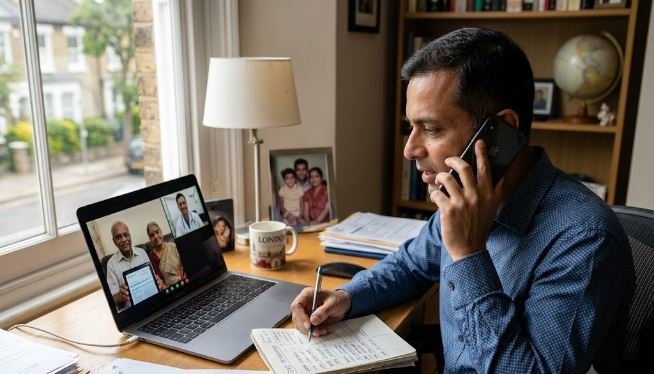
Your phone rings at 3 a.m. It’s a number from India. For a second, your stomach drops before you even answer. If you’re an NRI, you know this feeling. Distance doesn’t stop you from worrying about your parents — it just makes every worry harder to act on.
NRI managing aging parents healthcare is one of the hardest, most emotional parts of living abroad. You want to be there for a doctor’s appointment, a fall, or just a bad day. But you’re seven, ten, or twelve time zones away. The good news is that caring for parents in India from abroad has become far more manageable in the last few years. Telemedicine, home-care networks, and digital health records now let you stay genuinely involved, not just informed after the fact.
This guide walks through practical, no-nonsense ways to build a support system around your parents — one that works whether you live in Dubai, London, Toronto, or Sydney. No hard sell, no jargon. Just what actually helps.
Why NRI Managing Aging Parents Healthcare Feels So Hard
Managing a parent’s health from another country is different from managing your own. You’re relying on secondhand information. Your parents may downplay symptoms so you don’t worry. Local doctors may not know the full medical history. And when something urgent happens, you’re the last to find out and the least able to act quickly.
According to the India Ageing Report 2023 by UNFPA India, India’s elderly population is growing faster than its geriatric care infrastructure, and a large share of older adults now live without a child in the same city, let alone the same country. That gap is exactly why remote care planning has become essential, not optional, for NRI families.
Recognising this is the first step. The second is building small, repeatable systems so you’re not solving the same problem from scratch every time there’s a health scare.
Many NRIs also carry a quiet guilt about not being physically present. That guilt often pushes people into two extremes: constantly calling and trying to control every detail, or pulling back because it feels too painful to stay closely involved. Neither approach holds up over years. A steady, structured system is far more sustainable than constant worry or occasional check-ins.

Building a Local Care Team for Caring for Parents in India From Abroad
You cannot be the only line of defence. A trusted, local support system does the daily work you physically cannot do.
Start with these people
- A family doctor or geriatric physician your parents see regularly, with your contact details on file.
- A trustworthy neighbour or relative who can check in without being asked.
- A verified home-care agency or nurse for daily support, medication reminders, and vitals tracking.
- A designated hospital near their home, chosen and confirmed before an emergency, not during one.
Our complete guide to parents’ aging support services for NRIs breaks down how to vet home-care providers, what questions to ask, and how to set up a care plan that doesn’t fall apart the moment something goes wrong.
It helps to write down each person’s role clearly, even if it feels unnecessary at first. Who calls the doctor. Who pays the caregiver. Who checks in on Sundays. When roles are vague, small tasks get missed, and missed tasks are usually how minor health issues turn into hospital visits.
Remote Healthcare Monitoring India: Tools That Actually Help
Technology has closed a lot of the distance gap. You don’t need to wait for a phone call to know how your parents are doing.
Practical tools worth setting up
- Wearable devices that track blood pressure, heart rate, and blood sugar, with alerts sent to your phone.
- Shared digital folders for prescriptions, lab reports, and discharge summaries, so any doctor can access history instantly.
- A weekly video call that doubles as a soft health check, not just a chat.
- SOS or panic-button apps that alert both you and a local emergency contact at the same time.
Remote healthcare monitoring India solutions work best when they’re simple enough for your parents to actually use daily. A complicated app that sits unused helps no one. If you’re unsure where to start, our NRI care resource hub has step-by-step guides on setting up monitoring without overwhelming your parents.
NRI Elderly Parent Care Tips for Emergencies and Hospital Visits
Emergencies are where distance hurts the most. Preparation is the only real defence you have.
Before anything happens
- Keep a physical and digital emergency file: ID proofs, insurance details, allergies, current medications, and doctor’s contact numbers.
- Confirm who has legal authority to make medical decisions if your parent cannot.
- Pre-register your parents at a hospital you trust, so admission isn’t delayed by paperwork.
One of the most useful NRI elderly parent care tips is to arrange a specialist review before you fly home in a panic. MorningSun’s pre-travel teleconsultation service lets a specialist assess your parent’s condition over video first, so you land in India already knowing what tests, admissions, or procedures are actually needed. It saves time, and it saves you from booking an emergency flight for something that could have been handled with a scheduled visit.
The U.S. National Institute on Aging’s guide to advance care planning is a useful reference for organising legal and medical paperwork before a crisis, even though it’s written for a US audience. The principles of getting documents in order apply just as well to families managing care in India.
Coordinating Second Opinions and Specialist Care Without Flying Home
Not every health decision needs you on a plane. When a diagnosis feels uncertain, or a doctor recommends surgery, getting a second opinion can bring real clarity, and it can be done remotely.
A second medical opinion consultation through MorningSun connects your parent’s existing reports with an independent specialist, who reviews everything and gives you a clear recommendation. This is particularly useful when a local doctor’s advice feels rushed, or when the family simply wants confirmation before agreeing to a major procedure.
This approach also helps siblings or family members spread across different countries agree on a single course of action, instead of everyone forming a different opinion based on a five-minute phone call with the parent.

Don’t Overlook Daily Wellbeing, Not Just Medical Emergencies
Healthcare isn’t only about hospitals. Skin, joints, sleep, and mood all shift with age, and small, consistent care often prevents bigger problems later.
Many elderly parents deal with dry, sensitive skin, especially during winter months in North India. Gentle, natural approaches such as those covered in Advik Ayurveda’s guide to Ayurvedic anti-aging remedies can be a simple, low-risk addition to a parent’s daily routine, alongside their regular medical care, not instead of it.
Loneliness is another factor families underestimate. A parent who eats well and takes their medication but has no one to talk to for days is still at risk. Regular calls, local social groups, or even a paid companion visit can matter as much as any monitoring device.
Sleep quality, appetite, and mobility are worth asking about directly during calls, since parents rarely bring these up on their own. A parent who mentions they’ve stopped their evening walk, or that they’re sleeping poorly, is giving you an early signal worth following up on with their doctor, well before it becomes a bigger problem.
FAQs:
Set up a monthly medicine delivery through a local pharmacy or home-care agency, and keep a shared digital list of current prescriptions so any doctor or caregiver can check it instantly.
A combination of a wearable vitals tracker, a trusted local caregiver, and a weekly video call gives the clearest picture without being intrusive.
Yes. Specialists can review medical records, scans, and reports remotely and provide a written opinion through a teleconsultation, without the patient or family needing to travel.
Ideally, a relative or trusted neighbour who lives close by, backed up by a home-care agency’s emergency line. This person should have a copy of your parent’s medical history and insurance details.
Frame it as support for you, not a judgment of their independence. Many parents accept a caregiver more easily when it’s presented as peace of mind for their children, rather than a sign they can’t manage alone.
External Resources
- India Ageing Report 2023 — UNFPA India & IIPS
- National Programme for Health Care of the Elderly — National Health Mission, Government of India
- Advance Care Planning — National Institute on Aging (NIH)