
It usually starts small. A grandparent on a video call asks a five-year-old to say something in Hindi, and the child goes quiet, or answers back in English without missing a beat. Nobody says anything, but every parent on that call feels the same small tug — a mix of pride in how easily their child belongs in a new country, and a quiet worry about what might be slipping away in the process.
Raising Indian kids abroad traditions isn’t about recreating a childhood that no longer exists, even back home. It’s about deciding, piece by piece, what actually matters enough to pass on, and finding ways to do that inside a life that looks nothing like the one you grew up in.
This isn’t a checklist of festivals to celebrate or phrases to teach. It’s a look at what diaspora parents are actually navigating, what tends to work, and why the goal was never to raise a carbon copy of yourself in the first place.
Why Raising Indian Kids Abroad Feels Different From “Just Parenting”
Every parent worries about screen time, manners, and bedtime. Diaspora parents carry an extra layer most of their local friends never think about: whether their child will grow up feeling connected to a culture that exists mostly in memory, stories, and the occasional trip back.
It’s not that the culture disappears the moment a family moves abroad. It’s that it stops being the default. Back home, a child absorbs language, festivals, food, and manners just by living in the middle of it — school, neighbours, television, the sound of the street. Abroad, all of that has to be built on purpose, in the gaps between school runs and everything else that makes up an ordinary week.
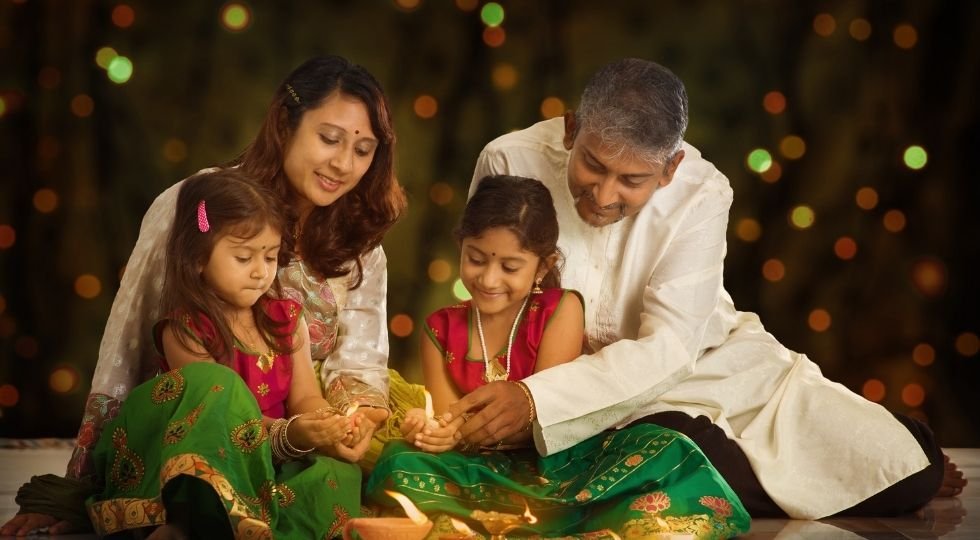
Raising Indian Kids Abroad Traditions: What Actually Gets Passed Down
Not every tradition survives the move, and that’s fine. What tends to matter most isn’t the grand gestures but the small, repeatable ones — the things a child experiences often enough that they become part of who they are, not just something they do once a year for a photo.
- Language, even at a basic conversational level, since it’s the thing that keeps them able to talk to grandparents without a translator.
- Food, cooked at home regularly rather than only on special occasions, so it feels ordinary rather than ceremonial.
- Festivals, celebrated with enough consistency that a child anticipates them the way they anticipate a birthday.
- Family stories, told casually and often, since these carry values in a way lectures never do.
- Small daily habits — a morning greeting, a way of eating, a phrase used at the dinner table — that quietly shape identity without ever being labelled as “culture.”
None of this requires perfection. A child doesn’t need fluent Hindi or a flawless understanding of every festival to feel Indian. They need enough consistent exposure that the culture feels like theirs, not like a subject they’re being taught.
Some families find that an actual trip back does more than years of explaining ever could. Morning Sun’s guide to cultural and heritage experiences in India covers immersive, family-friendly ways to make that visit count.
The Real Diaspora Parenting Challenges Nobody Warns You About
Most of the diaspora parenting challenges people talk about are practical — finding a temple, a Hindi class, or Indian groceries nearby. The harder ones are quieter.
The language slips faster than expected
Kids often understand a heritage language far longer than they speak it. Comprehension can stay strong for years while active speaking fades, especially once school becomes the dominant environment.
Kids notice the gap between two worlds
A child might feel completely at home at school and slightly out of place at a family wedding, or the reverse. That in-between feeling is normal, but it can catch parents off guard if they expected a clean, seamless identity.
Parents second-guess how much is “enough”
There’s no scoreboard for this. Some weeks feel like too little culture is getting through; other weeks feel forced and performative. Most diaspora parents live somewhere in between, and that’s not a failure — it’s just what balancing two worlds actually looks like.
Extended family expectations add pressure
Grandparents and relatives back home sometimes measure a child’s “Indian-ness” by fluency or ritual knowledge, which can make parents feel judged for choices that make sense in their day-to-day reality abroad.
NRI Parenting Tips That Actually Work in Daily Life
The families who manage this well aren’t necessarily the most culturally strict — they’re usually the most consistent. A few NRI parenting tips that tend to hold up over time:
- Keep one language rule simple and stick to it, like speaking the heritage language at home only, rather than trying to enforce it everywhere.
- Cook familiar meals often enough that they’re comfort food, not just “special occasion” food.
- Let kids see the culture in you, not just hear about it — your own habits, music, and language use teach more than instructions do.
- Connect with other diaspora families nearby, so children see that they’re not the only ones navigating two worlds.
- Treat visits to India as immersion, not just family duty — involve kids in markets, kitchens, and everyday life, not only temple visits and relative meetups.
Consistency beats intensity almost every time. A ten-minute bedtime story in Hindi three nights a week does more over a year than one ambitious cultural weekend that never gets repeated.
Many families keep small daily rituals alive with products from home. Advik Ayurveda ships its Ayurvedic skincare and haircare worldwide, so the oiling ritual your mother did for you doesn’t have to skip a generation.
Teaching Indian Culture to Children Abroad Without Making It Feel Like Homework
The fastest way to make a child resist their heritage is to turn it into an obligation. Teaching Indian culture to children abroad works best when it’s woven into things they already enjoy, rather than delivered as a lesson.
- Turn cooking into a shared activity instead of a solo chore — let them measure spices or shape rotis, even badly at first.
- Use music and dance as play, not instruction. A Bollywood dance-along in the living room teaches rhythm and language without anyone calling it a class.
- Answer their questions honestly, including the ones about why some things are done differently at home than at their friends’ houses. Curiosity handled with patience builds pride; curiosity dismissed builds distance.
- Let them choose which parts resonate.

Festivals, Food, and Language: The Three Anchors
If the whole picture feels overwhelming, these three areas alone carry most of the weight, and they reinforce each other naturally.
Festivals
Even a simplified celebration — diyas, a special meal, a phone call to grandparents — gives kids a yearly rhythm to look forward to and a reason to ask questions about where it all comes from.
Food
Shared meals are where language, stories, and habits all show up at once. A child who grows up eating dal and rice at the family table absorbs far more than the recipe.
Language
Even partial fluency keeps the door open. A child who can understand more than they can speak can still follow a grandparent’s story, sing along to a song, or ask for another helping in the language their family speaks.
Want to go deeper on the customs and rituals behind these traditions? Explore Desh Sansaar’s collection on Indian customs and rituals for the stories behind what your family already practices.
FAQs:
Consistency matters more than fluency. Simple phrases, songs, and bedtime stories in whatever heritage language you speak comfortably still build familiarity and comfort with the language.
Yes, this is extremely common once school becomes the dominant environment. It doesn’t mean the heritage language is lost — comprehension often stays strong even when active speaking drops.
There’s no fixed amount. What matters more than volume is consistency — a few meaningful, repeated traditions tend to stick better than an overwhelming, all-at-once approach.
Occasional gentle encouragement is fine, but forcing participation tends to build resentment. Letting kids connect with the parts of the culture that genuinely interest them usually leads to a more lasting connection.
Many diaspora parents find that even one immersive trip does more for a child’s sense of identity than years of explanation from abroad, especially when the visit includes everyday life and not just sightseeing.