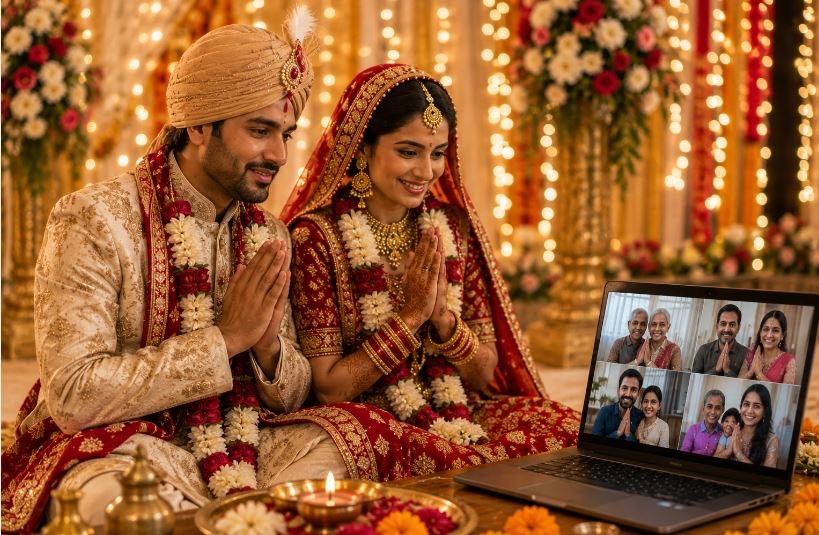
The guest list used to be simple: everyone lived within a few hours of each other, and a wedding date got picked around the harvest season or a convenient long weekend. That version of an Indian wedding barely exists anymore for a lot of families. The groom’s side is in Toronto, the bride’s cousins are in Dubai, an aunt who has to be there is in Melbourne, and grandparents who cannot travel are still in the village where the whole family started.
None of this makes the wedding less special. It just means the planning has to work harder to hold everyone together, and that work rarely gets talked about the way venue choices and outfits do.
This guide is for exactly that situation: planning an Indian wedding NRI family abroad can actually attend without anyone missing the moments that matter. It covers destination Indian weddings as a practical option, the real work of planning weddings across countries, and the NRI wedding logistics that quietly determine whether the day feels like a full family reunion or a smaller version of what it should have been.
Why Indian Weddings Feel Different When Family Is Scattered
An Indian wedding was never really about two people. It is built around a huge web of relatives, rituals that need specific people present, and a shared understanding that everyone shows up for everyone else’s big day. When a third of that web lives on a different continent, every decision, the date, the venue, even which rituals to keep, starts running through a filter that older generations never had to think about.
This isn’t a smaller problem than it looks. Missing a grandparent at the pheras, or a sibling who couldn’t get leave approved in time, changes how the day is remembered for the whole family, not just the couple.
There’s also a quieter shift happening underneath the logistics. Families who once took a full house of relatives for granted now treat a wedding as one of the rare moments everyone might actually be in the same room again, which raises the stakes on getting the planning right well beyond the usual wedding-day pressure.
Want a fuller walkthrough of planning across borders?
Destination Indian Weddings: A Practical Middle Ground
A destination wedding isn’t automatically the answer for a scattered family, but it solves a specific problem well: instead of asking everyone to travel to one relative’s hometown, it picks neutral ground that’s roughly fair to travel to for most of the guest list.
Choosing a Location Everyone Can Actually Reach
A destination wedding for a scattered family isn’t about a scenic backdrop first, it’s about travel time fairness. Goa, Udaipur, and Jaipur remain popular precisely because they sit within reasonable flight connections from the Gulf, Europe, and increasingly North America, while still feeling unmistakably Indian for guests coming from abroad.

What Changes When the Wedding Isn’t ‘Back Home’
Moving the wedding away from the family’s home city changes more than logistics. Local relatives who would normally help with everything from decor to catering now need to travel too, which can shift who ends up doing the informal work a big wedding always generates. It’s worth naming this early rather than assuming it will sort itself out.
Planning Weddings Across Countries: The Logistics No One Warns You About
The venue and the outfits get most of the planning attention. The details below get far less, and they’re usually the ones that actually determine whether guests arrive stressed or ready to celebrate.
Timing Around Multiple Calendars and Visa Windows
An auspicious date matters, but so does whether your Australia-based cousin can get four consecutive days off and whether your US relatives’ visa processing time actually fits the timeline. The Government of India’s official e-Visa portal is the only place to check current processing times and eligibility, since third-party sites often quote outdated information.
Budgeting Across Currencies and Cost Expectations
Costs quoted in rupees can look deceptively small to guests earning in dollars, pounds, or dirhams, and deceptively large to relatives still living in India. Being upfront and specific about what’s covered by the hosts versus what guests are expected to handle themselves, flights, specific outfits, gifts, avoids awkward surprises closer to the date.
Vendors Who Actually Understand Remote Coordination
Not every wedding planner is set up for clients managing details from a different time zone. Ask directly how they handle video walkthroughs, digital mood boards, and payment processing for overseas family members before signing anything.
NRI Wedding Logistics: A Practical Checklist
A lot of this comes down to starting earlier than feels necessary. What looks like plenty of lead time in a normal planning timeline often isn’t, once visas, flights, and multiple households’ schedules are added into the mix.
- Confirm passport validity and visa requirements for every travelling guest at least four months out, not four weeks.
- Build a shared, living document with flight windows, so overlapping arrival times can be used for group airport pickups.
- Set a single point of contact for local vendor coordination, rather than splitting communication across multiple family members in different time zones.
- Plan a buffer day before the main events for jet-lagged guests, especially older relatives making a long-haul trip.
- OCI cardholders: confirm your card details are current well ahead of travel; the Ministry of External Affairs’ OCI scheme page outlines eligibility and renewal details directly from the source.
Keeping Rituals Meaningful When Guests Join Virtually
Not everyone will make it, and that’s worth planning for honestly rather than around. A grandparent recovering from surgery, a sibling on a visa timeline that just doesn’t line up, these situations are common enough that most families now build a livestream plan into the wedding budget from the start, not as an afterthought.
The difference between a livestream that feels like an afterthought and one that feels like real inclusion usually comes down to a handful of small decisions made in advance, not on the day itself.
- Assign someone specifically to manage the stream, not a guest who will also be busy with their own role in the ceremony.
- Position a camera for key rituals like the haldi and pheras specifically, rather than a single wide shot of the whole venue.
- Send a small ritual item, a pinch of the haldi paste, a piece of the mandap flowers, to family who couldn’t attend, so the moment feels less one-sided.
Preparing your own pre-wedding beauty ritual?
The Emotional Weight Behind the Logistics
Underneath every spreadsheet and vendor call sits something harder to plan for: the quiet grief of a wedding that won’t look the way it would have if everyone still lived in the same city. It’s easy to let the logistics absorb all the attention precisely because they feel more solvable than the feeling underneath them.
If this feels familiar, it’s worth reading alongside our piece on the guilt of living abroad while parents age alone, since the same distance that complicates a wedding often shows up in other family milestones too. Naming that weight honestly tends to make the planning itself feel less heavy.

Practical Support Along the Way
Big family gatherings are also, often, when relatives finally get around to a health checkup or a wellness visit they’ve been postponing while abroad. If extended family are combining the trip with any medical or wellness appointments in India, MorningSun’s travel and visa assistance service can help streamline that side of the trip alongside the wedding travel itself.
Conclusion
A scattered family doesn’t have to mean a smaller wedding, it usually just means a more deliberately planned one. Pick a location guests can realistically reach, build in buffer time for jet lag and visas, name the emotional weight rather than pretending it isn’t there, and make room, even virtually, for the people who cannot physically be present. Done well, the distance becomes part of the story the family tells about the day, not a footnote to it.
FAQs:
At least four months ahead, given processing times can vary.
Cities with strong international flight connectivity, like Goa or Delhi.
A well-planned livestream with dedicated camera coverage of key rituals.
Be explicit early about what hosts cover versus guest expenses.
No, but OCI card details should be confirmed as current before travel.
External Resources
1. Government of India — Indian Visa Online (Official e-Visa Portal) (Bureau of Immigration, Government of India)
2. Ministry of External Affairs — Overseas Citizenship of India (OCI) Scheme (Government of India)
3. Bureau of Immigration — e-Arrival Card (Government of India)